COMRAD: A Benchmark for
Embodied Multi-Agent
Reinforcement Learning

A standardized embodied MARL benchmark combining 3D egocentric visual observations, procedural map generation, and baselines algorithms.

Khoi H.B. Nguyen,  Dimitar Zhivkov Zhekov,  Tristan Tomilin

13
Cooperative Scenarios
7
CTDE Baselines
~25K
Frames / Second on 1 GPU
2–8
Agents per Scenario

Abstract

Benchmarks are central to the development and evaluation of multi-agent reinforcement learning (MARL) algorithms. As the cooperative MARL community has grown, two categories of evaluation environments have proven indispensable: low-dimensional feature-vector benchmarks that isolate algorithmic behavior in compact state spaces, and two-dimensional pixel-based benchmarks that rely on overhead visual observations. However, to bridge the gap to real-world embodied settings such as robotics and autonomous navigation, algorithms must handle high-dimensional, 3D egocentric visual complexity. While various 3D environments have been explored for vision-based RL, no existing platform simultaneously provides a standardized, purely cooperative multi-agent benchmark with 3D first-person observations and high-throughput simulation.

To address this gap, we introduce COMRAD, a COoperative Multi-Agent Reinforcement LeArning benchmark suite in Doom, featuring a diverse set of challenging scenarios spanning role asymmetry, temporal synchronization, and spatial navigation.

To introduce within-scenario variability, we develop DoomGen, a procedural map generator that produces diverse layout configurations for every scenario. We integrate COMRAD with Sample Factory, a high-throughput asynchronous RL framework, and implement seven MARL baselines on top of it, reaching ~25K frames per second during training. Our experiments show that COMRAD poses significant challenges for current CTDE methods, establishing visual cooperative MARL as an important open frontier.

What We Introduce

01
13 Cooperative Scenarios
Social dilemmas, role asymmetry, spatial & temporal sync, and combat; all 3D first-person.
02
DoomGen + ACL
Voronoi procedural maps with independent task & spatial difficulty axes for curriculum learning.
03
7 CTDE Baselines
IPPO, MAPPO, HAPPO, IDQN, VDN, QMIX, QPLEX.

13 Cooperative Scenarios

Agents coordinate solely from their local 3D first-person visual observations: no shared state, no explicit communication.

Scenario taxonomy across four cooperation dimensions
Cooperation properties of all 13 COMRAD scenarios across four analytical dimensions, confirming diversity across coordination challenge types.
COMRAD demo for 2 agents
Stag Hunt Arena Easy - D1
Stag Hunt Arena
Resolve the hare-vs-stag dilemma under partial observability.
Rhythm Sync Medium - D3
Rhythm Sync
Synchronize temporal switches without communication.
Foraging Commons Medium - D3
Foraging Commons
Balance individual harvesting against replenishing a shared pool.
Co-op Puzzle Medium - D3
Co-op Puzzle
Sequentially unlock gates in a strict turn-based progression.
Platform Chain Hard - D4
Platform Chain
A physical tether constrains agents to maintain proximity.
Armory Siege Hard - D4
Armory Siege
Defend a core while rotating members to collect distant resources.
Coop Health Gathering Hard - D4
Co-op Health Gathering
Navigate a decaying health field together to maximize overlap.
Lava Pit Difficult - D5
Lava Pit
Alternate holding pressure plates to support crossings over lava.
Smart Enemies Difficult - D5
Smart Enemies
Enemies accelerate under concentrated fire, forcing dispersion.
Dumb Enemies Difficult - D5
Dumb Enemies
Enemies flee solo agents but slow near groups: cooperative pursuit.
Ammo Carrier Severe - D6
Ammo Carrier
A mobile carrier resupplies a stationary defender continuously.
Stealth Labyrinth Very Difficult - D7
Stealth Labyrinth
Torch-gunner pair survives under extreme asymmetric observability.
Lava Maze Very Difficult - D7
Lava Maze
Emergent communication between a navigator and a remote signaller.

Methodology

High-throughput infrastructure, procedural generation, and curriculum learning form the backbone of COMRAD.

Training Architecture
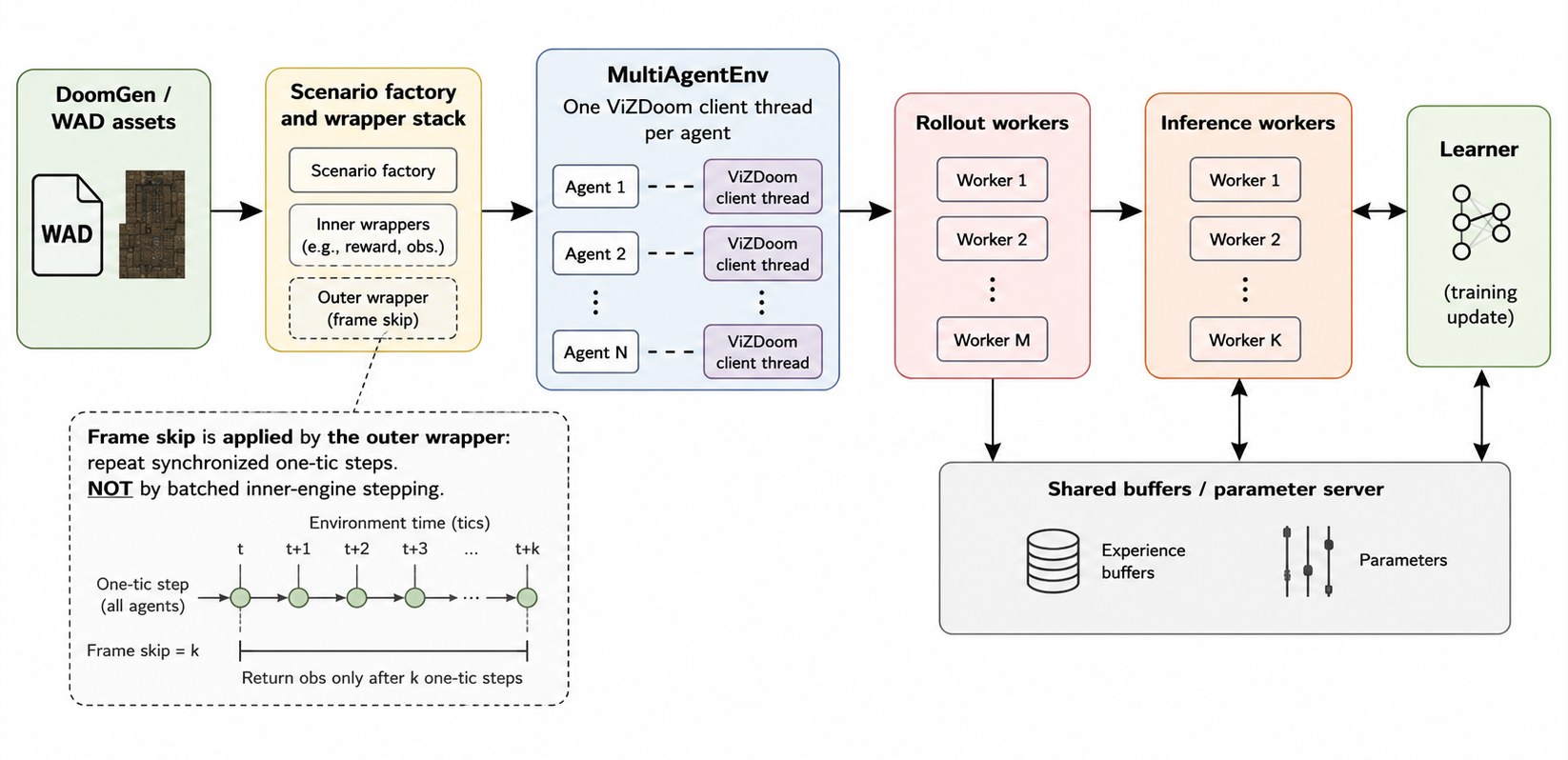
COMRAD integrates with Sample Factory, enabling highly parallelized asynchronous RL that achieves ~25K FPS during training on a single GPU. Rollout workers run ViZDoom instances in parallel on CPU while policy workers and the learner batch inference and optimization on GPU.
High-level Architecture Overview
High-level asynchronous training architecture integrated with Sample Factory.
Training Architecture Details
Detailed view of the distributed rollout and learning components over CPU and GPU.
DoomGen: Procedural Map Generation

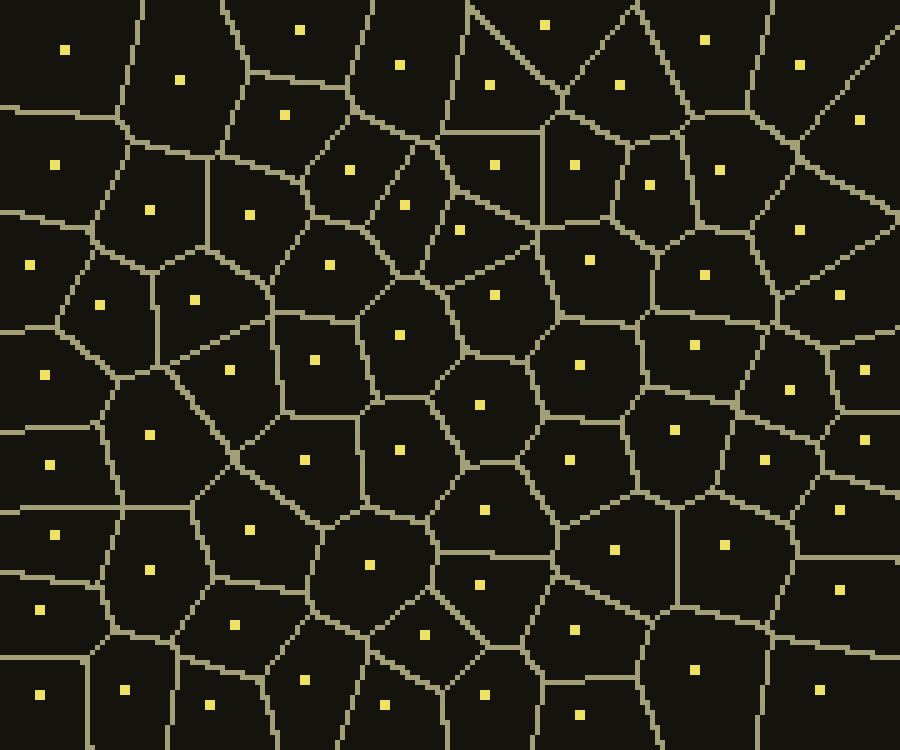
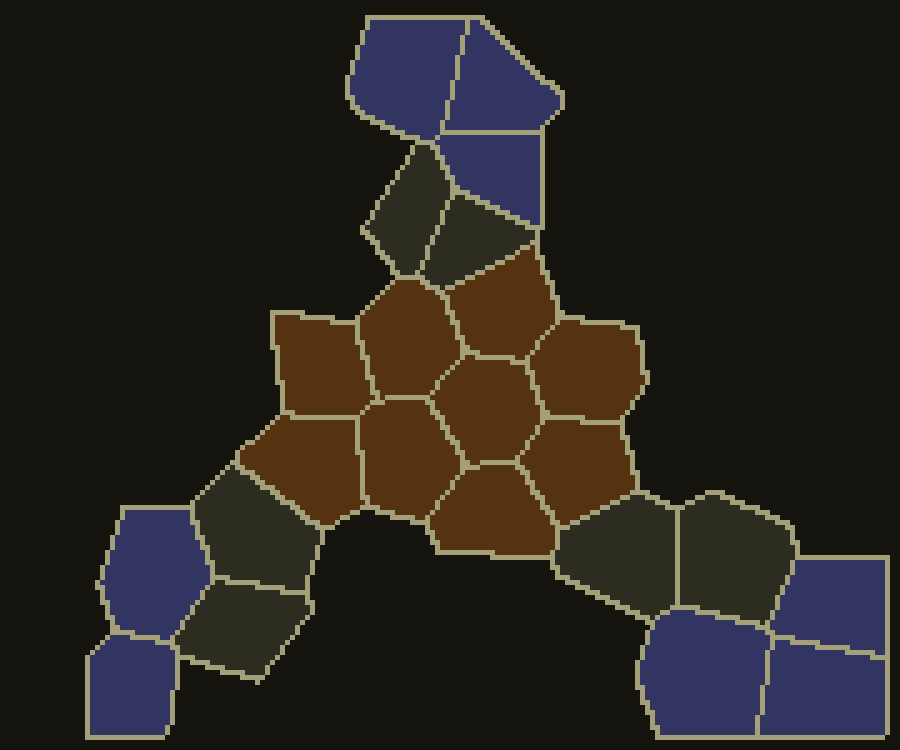
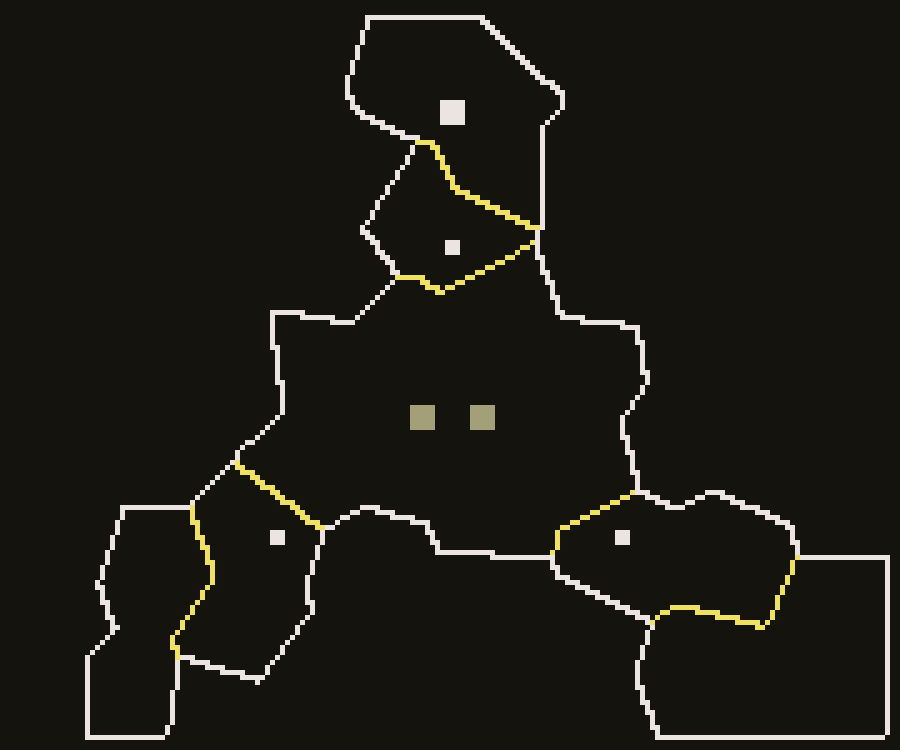
To make spatial memorization as difficult as possible, DoomGen avoids traditional orthogonal, grid-based room layouts. It constructs maps starting from a relaxed Voronoi tessellation, grouping irregular cells into semantically defined areas before translating the graph into valid Doom geometry.

This geometric irregularity broadens the distribution of boundary shapes, geometries, sightlines, and local visual cues, exposing algorithms to a distribution of spatial configurations rather than a single memorizable map, while still preserving task semantics.

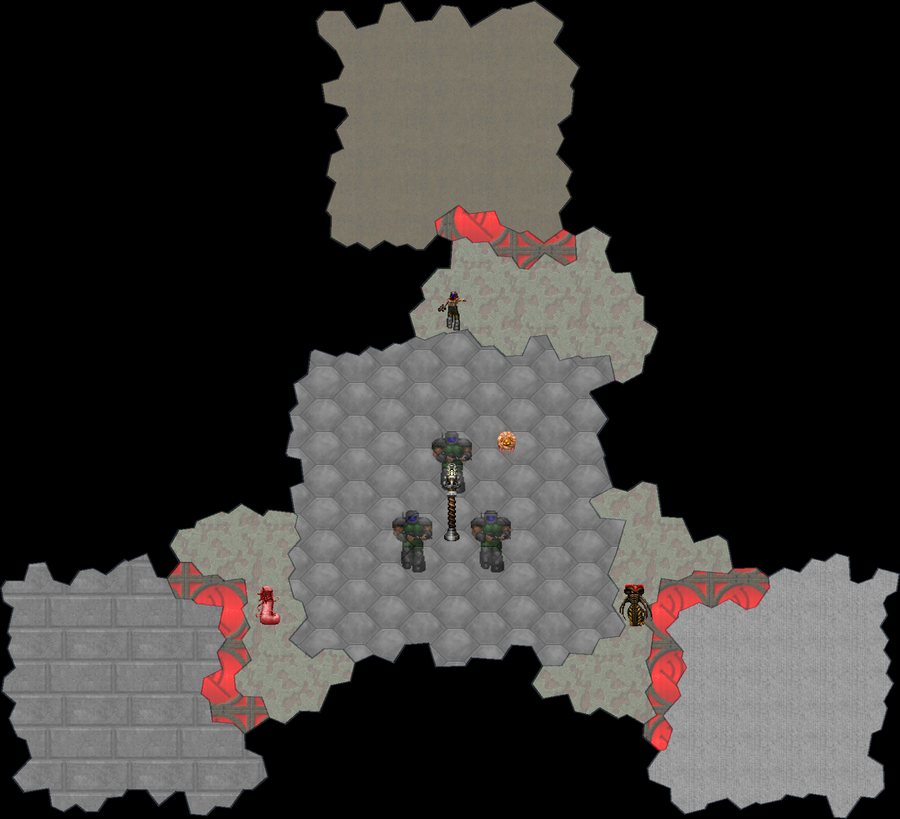
DoomGen Example - Armory Siege Variants
Six Armory Siege layouts generated from the same scenario template under different seeds.
Automated Curriculum Learning
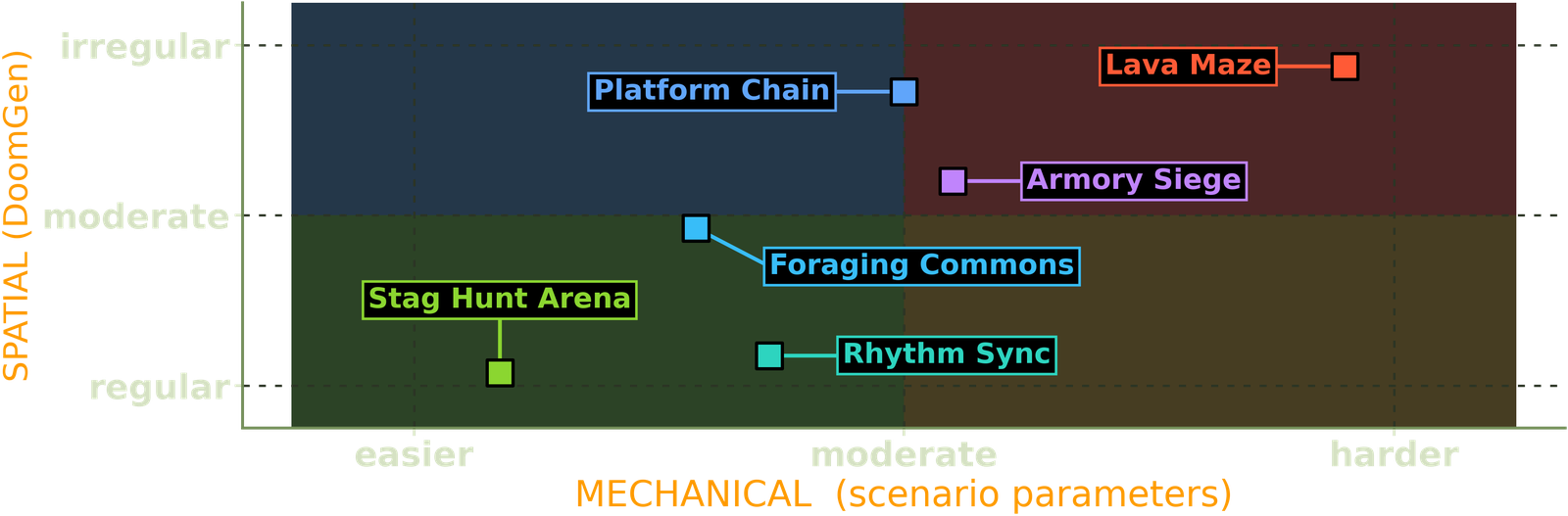
COMRAD factorizes per-scenario difficulty into two independent, orthogonal difficulty axes: task-mechanical difficulty and spatial difficulty.
Two orthogonal difficulty axes: task-mechanical and spatial difficulty
The two difficulty axes factorized in COMRAD: task-mechanical vs. spatial complexity.

Task-mechanical difficulty controls scenario parameters (enemy count, time limits, hazard intensity) that shape the coordination challenge within a fixed map topology. Spatial difficulty controls layout complexity produced by DoomGen, from compact single-room arenas to sprawling multi-wing labyrinths.

Scaling one axis while holding the other fixed isolates whether a method fails from task demands or spatial generalization, allowing sharper experimental conclusions across curriculum, transfer, and generalization studies.


To evaluate this curriculum design, we compare six protocols on the Platform Chain task pool: Direct Training (static sampling of the hardest target instance), Uniform (all instances sampled equally, isolating instance diversity without adaptive selection), Sequential (strict ordering by difficulty, advancing on rolling-mean success), Learning Progress (LP) (prioritizes instances with the highest temporal disagreement), OMNI (frontier-ordering graph mask that suppresses mastered or unreachable instances), and PLR (Prioritized Level Replay) (scores instances by learning potential, blending value error with staleness):
Curriculum Protocol Best
Sample efficiency across curriculum protocols on the Platform Chain task pool. PLR reaches a competitive checkpoint at only 19.1M steps, outperforming sequential progression and OMNI in convergence speed under identical budgets.
Curriculum Protocol Retained
Retained-checkpoint strength on Platform Chain. Sequential progression achieves the highest peak score (6.94), while OMNI preserves the strongest final retained checkpoint (5.38), highlighting a trade-off between peak performance and stability.

Results

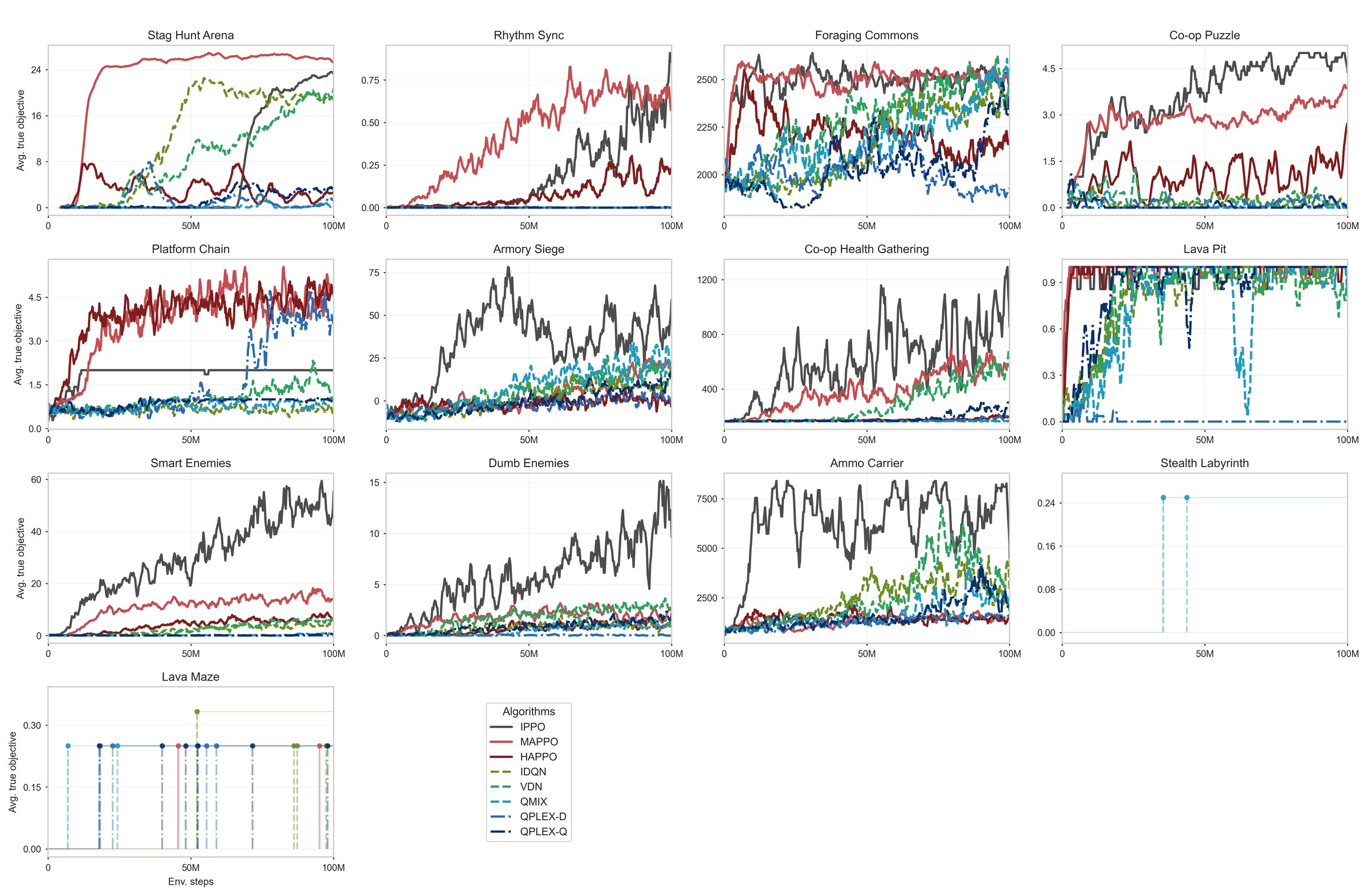
Performance of 7 established CTDE baselines across all 13 COMRAD scenarios under a 100M-step training budget.

Scenario IPPO MAPPO HAPPO IDQN VDN QMIX QPLEX-D QPLEX-Q Ceiling
Stag Hunt Arena17.55 ± 0.2225.66 ± 0.322.58 ± 0.1014.33 ± 0.1817.96 ± 0.390.28 ± 0.061.49 ± 0.103.42 ± 0.2036
Rhythm Sync0.59 ± 0.050.65 ± 0.050.22 ± 0.020.00 ± 0.010.00 ± 0.010.00 ± 0.010.00 ± 0.010.00 ± 0.011.00
Foraging Commons2355.64 ± 30.332510.93 ± 31.182199.89 ± 39.312190.70 ± 32.662327.13 ± 42.842544.89 ± 46.771905.26 ± 23.662345.75 ± 39.3821000
Co-op Puzzle3.03 ± 0.073.88 ± 0.092.23 ± 0.140.03 ± 0.010.07 ± 0.020.00 ± 0.010.00 ± 0.010.07 ± 0.035
Platform Chain2.00 ± 0.024.78 ± 0.194.67 ± 0.180.68 ± 0.061.12 ± 0.080.97 ± 0.023.40 ± 0.220.97 ± 0.0347
Armory Siege16.71 ± 2.9019.87 ± 2.32-0.71 ± 1.0710.97 ± 0.9818.32 ± 1.4623.12 ± 3.831.19 ± 0.8914.13 ± 2.47100
Co-op Health Gathering1104.90 ± 117.30553.96 ± 27.82197.74 ± 7.98164.20 ± 2.12573.83 ± 27.28166.43 ± 2.07193.95 ± 5.10267.78 ± 18.392100
Lava Pit0.92 ± 0.011.00 ± 0.011.00 ± 0.010.92 ± 0.010.80 ± 0.050.97 ± 0.030.00 ± 0.011.00 ± 0.0111
Smart Enemies11.56 ± 0.8614.23 ± 0.656.85 ± 0.383.30 ± 0.234.89 ± 0.380.64 ± 0.080.00 ± 0.010.65 ± 0.0784
Dumb Enemies12.44 ± 1.932.29 ± 0.201.03 ± 0.131.07 ± 0.112.76 ± 0.221.10 ± 0.150.00 ± 0.011.80 ± 0.1690
Ammo Carrier7052.93 ± 483.171362.73 ± 69.091340.99 ± 58.073836.13 ± 384.962542.51 ± 219.252379.46 ± 139.551530.98 ± 59.062080.97 ± 192.028400
Stealth Labyrinth0.00 ± 0.010.00 ± 0.010.00 ± 0.010.00 ± 0.010.00 ± 0.010.21 ± 0.010.00 ± 0.010.00 ± 0.011.00
Lava Maze0.00 ± 0.010.00 ± 0.010.00 ± 0.010.00 ± 0.010.00 ± 0.010.00 ± 0.010.00 ± 0.010.00 ± 0.016
Full baseline matrix at the 100M-step frontier. Entries report mean ± 95% CI over five independent runs (seeds 42, 68, 81, 97, 154). Bold orange = best per scenario. Ceiling = theoretical maximum under optimal play.
Learning Curves
Learning curves aggregated over multiple seeds, highlighting sample efficiency and stability differences across algorithm families.
Policy Family Gap
Scenario-normalized gap between the strongest on-policy and off-policy baselines. On-policy actor-critic methods lead in 8 of 13 scenarios.

When Centralized Training Hurts

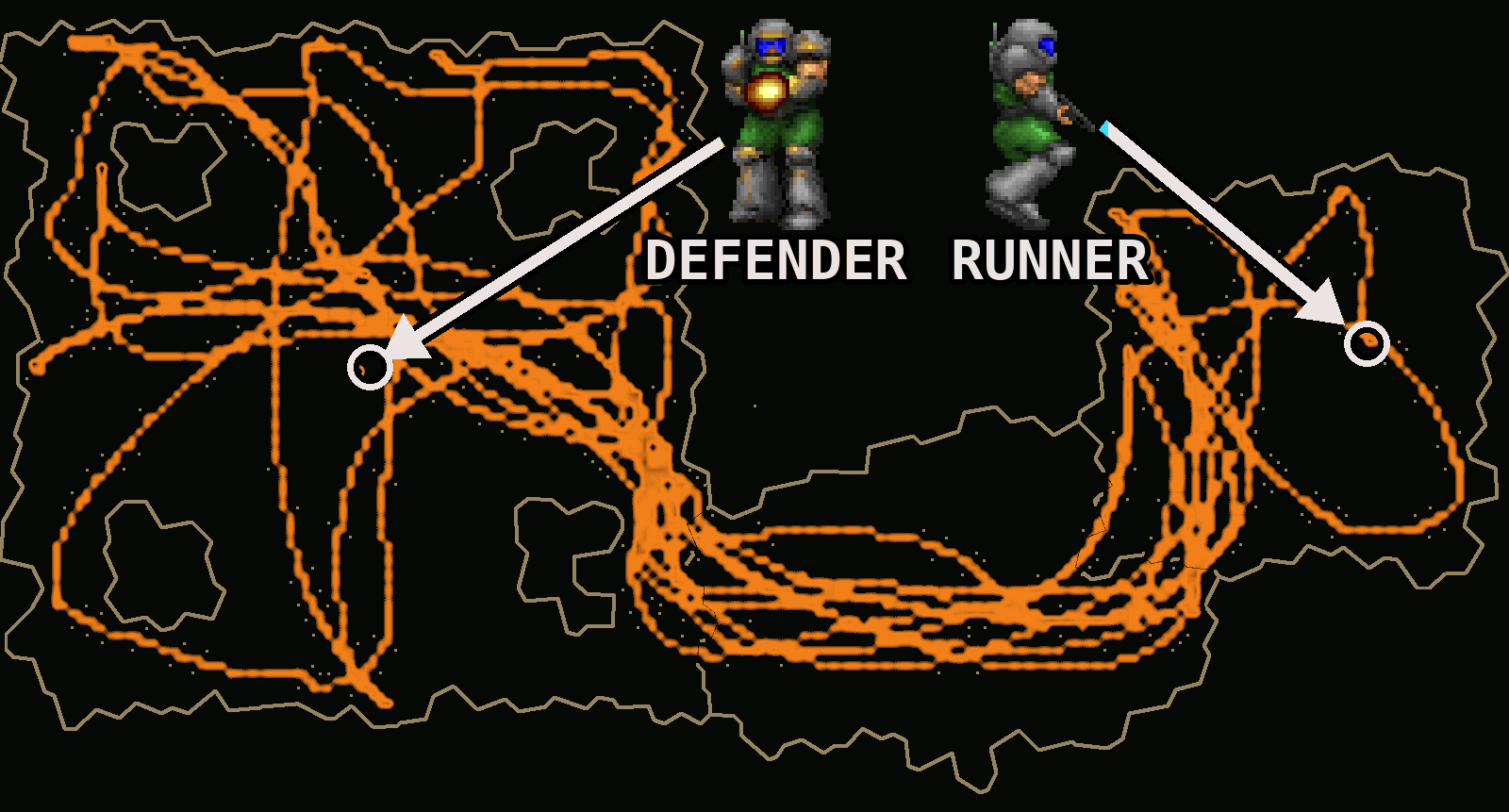
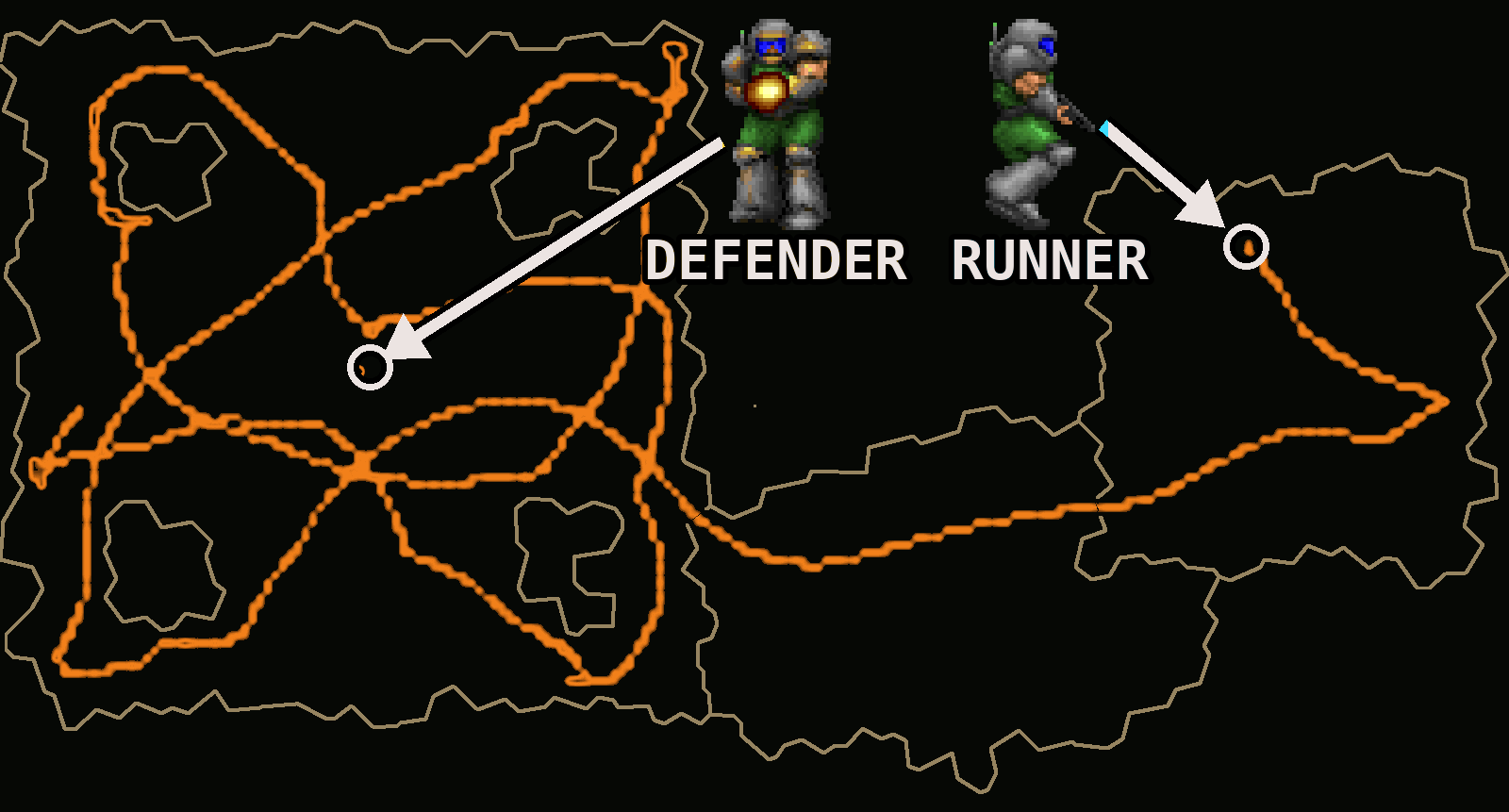
Visualizing spatial coordination and division of labor between agents in the Ammo Carrier scenario.

IPPO — Trajectory Heatmap
HAPPO — Trajectory Heatmap

Why IPPO Outperforms HAPPO on Ammo Carrier

Objective: Ammo Carrier is a fixed-role asymmetric defense task. One immobilized defender holds the hub against enemies, while a mobile runner maintains a depot-to-hub resupply loop. The challenge lies in learning a stable, long-horizon logistics routine with delayed, role-specific payoffs.

IPPO (Left): Decentralized updates allow the runner to independently optimize its loop without cross-agent interference. IPPO concentrates movement along a recurring depot-to-hub corridor, successfully learning the required role-specialized logistics behavior.

HAPPO (Right): Centralized training creates counterproductive coordination pressure. The runner's gradient updates are influenced by the defender's value signal, causing it to abandon the logistics routine. This lead to episodic ammo starvation and significantly lower survival times.

Citation

@inproceedings{nguyen2026comrad,
  title={{COMRAD}: A Benchmark for Embodied Cooperative Multi-Agent Reinforcement Learning},
  author={Khoi H.B. Nguyen and Dimitar Zhivkov Zhekov and Tristan Tomilin},
  booktitle={New Frontiers in Game-Theoretic Learning - NExT-Game},
  year={2026},
  url={https://openreview.net/forum?id=bXau6dlyV4}
}